Your degree is not your passport anymore.

Skills over degrees an blog image
May 6, 2026

Studytrek editorial: Skills over degrees — the global employability crisis and what it means for you

Studytrek Private Limited  ·  Director’s Desk
May 2026
Special Report  ·  Higher Education & Future of Work

Your degree is not
your passport anymore.

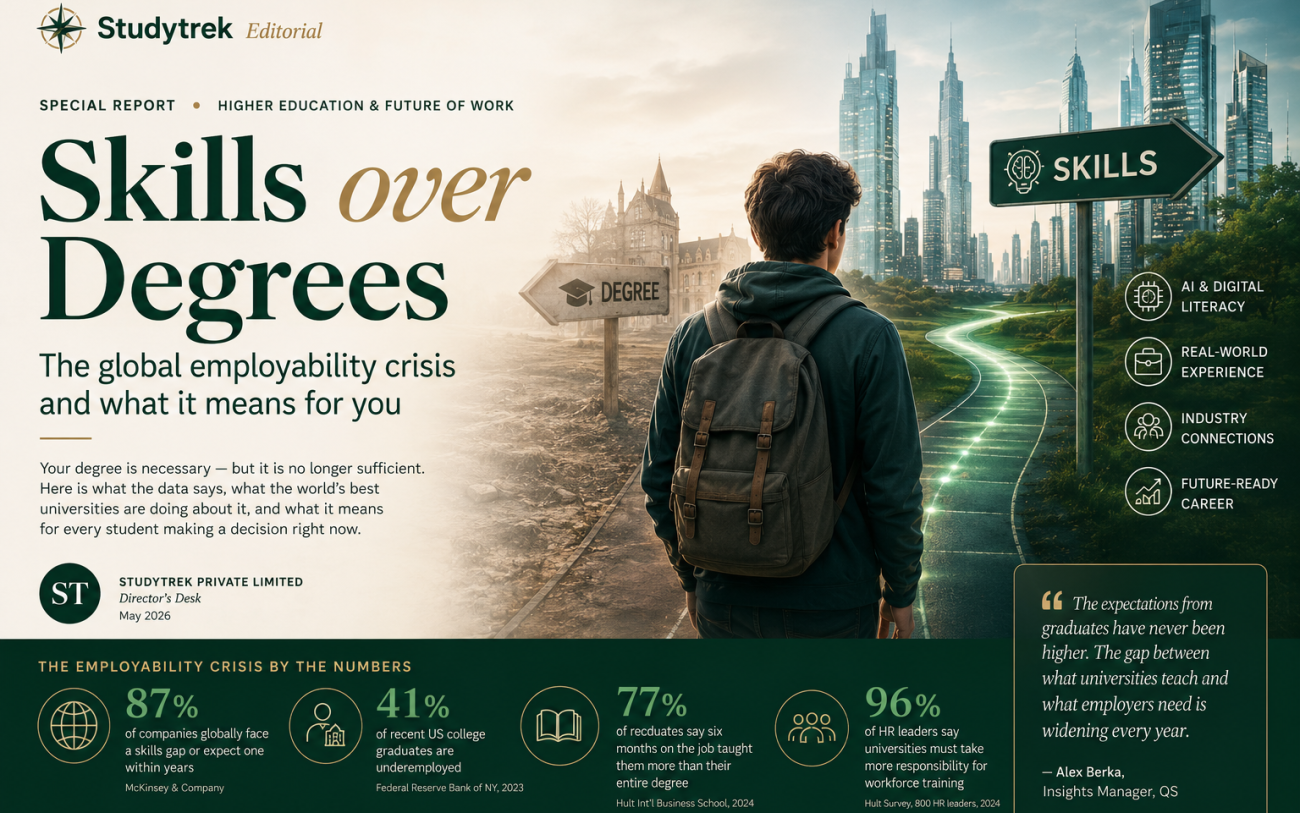
More than half of university graduates worldwide are entering a workforce that doesn’t consider them fully ready. The credential you’re working toward is necessary — but it is no longer sufficient. Here is what the data says, what the world’s best universities are doing about it, and what it means for every student making a decision right now.

Picture this: you spend four years — and a significant amount of money — earning a degree from a respected university. You graduate. You apply for jobs. And then a recruiter tells you, politely, that you’re not quite what they had in mind. Not because you’re unqualified. Because you’re not work-ready.

This isn’t a hypothetical. It is happening to graduates across South Asia, Southeast Asia, Europe, and the United States at a scale that employers, economists, and now universities themselves can no longer ignore. And the gap between what a degree signals and what a job actually demands has been widening — quietly, steadily — for over a decade.

“The expectations from graduates have never been higher. The seismic shifts in automation, artificial intelligence and the new economy are only widening the gap between what universities teach and what employers need.”

— Alex Berka, Insights Manager, QS · EduData Summit 2024

A decade of evidence the system is broken

The employability crisis is not new. But the data from the last ten years has made it undeniable. Across every major research body that tracks the relationship between higher education and workforce outcomes, the same conclusion emerges: the credential is outpacing the capability.

Global employability crisis — key indicators
Multiple sources, 2022–2025
87%
of companies globally face a skills gap or expect one within years
McKinsey & Company

41%
of recent US college graduates are underemployed in roles below their qualification
Federal Reserve Bank of NY, 2023

77%
of graduates say six months on the job taught them more than their entire degree
Hult Int’l Business School, 2024

96%
of HR leaders say universities must take more responsibility for workforce training
Hult Survey, 800 HR leaders, 2024

Only 24% of recent graduates believe they have all the skills their current role demands — a finding from a Hult International Business School survey of 800 HR leaders and 800 young employees in the United States. Read that again. Three in four graduates feel underprepared on the job. And the employers agree: fewer than half of HR leaders said new hires “always” or “often” arrive with the critical thinking, communication, or adaptability the role requires.

Employer satisfaction vs. skill importance — APAC employers
QS Global Employer Survey 2024 · 85,000+ responses, 80 countries
Problem-solving & critical thinkingLow satisfaction
Ranked #1 in importance by employers — ranked lowest in graduate readiness

Communication (verbal & written)Low satisfaction
Curricula rarely assess real-world communication in professional contexts

Resilience & adaptabilityLow satisfaction
Near-impossible to develop through exams alone

AI & digital literacyCritical gap
Fastest-growing employer demand; slowest-moving curriculum update area

Teamwork & collaborationModerate
Partial credit — project-based learning helps, but inconsistently delivered

The cost of getting this wrong is not just personal. McKinsey estimates the global skills gap could strip $8.5 trillion in annual revenues from the world economy by 2030. Businesses in the US alone spend $3.4 billion every year on remedial training for entry-level employees — training that, by rights, should have happened during the degree.

Skills are becoming the new curriculum architecture

Here is the important counterpoint: the universities that matter most in global hiring have read the same data. And they are changing — faster than most students realise.

The AI education surge — program growth timeline
Chronicle of Higher Education · The Pursuit · NACE 2024
2022

Carnegie Mellon launches the first undergraduate AI degree in the US
A turning point — AI moves from postgraduate specialisation to a core undergraduate discipline. Signalled a structural shift in how universities define technical education.

2023

AI-related university job postings more than double in a single year
Chronicle of Higher Education data shows AI postings outpaced general listings growth by nearly 2:1. Five institutions — CMU, UPenn, Northeastern, Clemson, U. of Florida — accounted for nearly half of all AI-related openings.

2024

Harvard Business School integrates generative AI into case-based learning
HBS begins using AI to simulate complex market conditions for student decision-making scenarios. Generative AI job postings rise 250%+ since 2021. MBA in AI programs surge 1,260% since 2022.

2025

US bachelor’s AI programs grow 114% in a single year — 90 to 193 programs
Northwestern, the University of Florida, and dozens of others launch dedicated AI majors. OpenAI convenes an education summit with Harvard, MIT, Stanford, Oxford leaders to co-design AI governance frameworks for higher ed.

2026

Work-integrated learning becomes a core ranking criterion globally
GEURS 2026 — the largest employer-vote ranking in the world (119,967 votes, 32 countries) — now weights industry embeddedness and skills outcomes alongside traditional academic metrics. France, Germany and China lead; Asia gains 5 more top-250 positions.

What’s driving this? Employers, particularly in STEM and tech, have begun communicating something crucial to admissions offices: they want graduates who arrive with demonstrable skills, not just transcripts. The GEURS 2024 survey — 100,700 employer votes across 21 countries — found that digital literacy and STEM specialisation were the top two hiring criteria, ahead of university brand in most countries.

Fastest-growing roles — employer demand 2025–2030
World Economic Forum, Future of Jobs Report 2025
AI & machine learning specialists+40%
Fastest-growing role for the second consecutive WEF report

Data analysts & scientists+35%
60%+ of hiring managers cite data science as hardest to fill in 2024

Cybersecurity specialists+31%
Global shortfall: 3.12 million qualified professionals — ISC² 2024

Sustainability & ESG analysts+28%
Emerging fast across finance, manufacturing, and infrastructure

Bank tellers / data entry clerks−26%
Among the steepest projected declines — automation exposure is high

The student’s dilemma — and how to resolve it

If you are a student choosing a university, a program, or a country to study in, this data changes the questions you should be asking. Not just “which university is ranked highest?” but “what will I be able to prove when I walk out the door?”

The old checklist
University brand / rank
Degree title on a CV
GPA / percentage
Number of years studied

The new checklist
Work-integrated learning built into the degree
Industry-recognised credentials alongside the degree
Demonstrable AI / digital literacy in your field
Employer partnerships and real project portfolios

The WEF projects that 39% of workers’ skills will be obsolete within five years. The OECD highlights that only 11% of working-age adults in the EU were enrolled in any continuing education as of 2019. The implicit contract — study once, work forever — is broken. The universities now winning on employability rankings (GEURS 2026 top performers include Germany, France, Switzerland and Singapore) are those that embed this reality into their programs from day one.

For students reading this
Five questions to ask before you commit to any program
01Does the program include mandatory industry placements, internships, or live project components — not optional add-ons?
02Are there AI or emerging technology modules embedded across disciplines — not just in computer science?
03What percentage of graduates from this program are employed in their field within six months of graduation?
04Does the institution appear in the GEURS top 250 — the only university ranking built entirely on employer votes?
05Will you leave with a portfolio of work — real outputs, real problems solved — or only exam scores?


What we tell every student who walks through our door

At Studytrek, we have watched this shift unfold in real time — in the profiles of students we place, in the feedback we receive from employer partners, and in the outcomes data we track from 2015 to today. The students who fare best in the global job market are not necessarily those who attended the most prestigious institutions. They are the ones who treated their degree as a foundation, not a finish line.

They took on real projects. They built demonstrable skills in fields that are growing — AI, data, sustainability, global communication. They chose programs that placed them in the world before graduation, not after. And they understood that in a world where 87% of companies are already navigating a skills gap, the graduate who walks in with evidence of what they can do is worth exponentially more than one who walks in with only a certificate of what they studied.

“A+ work stems from individuality, not automation. By resisting the temptation to outsource creativity entirely to AI, students can cultivate the distinctiveness that drives innovation.”

— Matthew Rascoff, Vice Provost for Digital Education, Stanford University

The global university system is correcting itself. The best institutions are moving toward skills-first, work-integrated education at a pace that was unimaginable even five years ago. Your job — as a student making one of the most consequential decisions of your life — is to find those programs, understand what they actually deliver, and use that knowledge to put yourself on the right side of a widening gap.

The degree still matters. But what you build alongside it will determine everything.


Data sources: McKinsey & Company Global Skills Survey · World Economic Forum, Future of Jobs Report 2025 · QS Global Employer Survey 2024 (85,000+ responses, 80 countries) · GEURS 2024 & 2026 — Emerging / Times Higher Education · Federal Reserve Bank of New York, Graduate Outcomes 2023 · Hult International Business School / Walr Survey 2024 · Ernst & Young Global Workforce Report 2024 · OECD Adult Skills Outlook 2024 · Asia Careers Group, Graduate Outcomes Tracking 2015–2024 · NACE 2024 Competency Report · IE Business School Insights 2025 · Chronicle of Higher Education, AI in Higher Ed 2023–24 · ISC² Cybersecurity Workforce Study 2024


Make a Comment

Dr. Ravi Gunupuru

Author Image
Independent Academic & Technology Consultant, Hyderabad, Telangana, India

About Us

StudyTrek is a leading overseas education consultancy dedicated to helping students access world-class education opportunities.

StudyTrek is a trusted name among study abroad consultants in India, helping students achieve their dreams of global education. With personalized counseling, expert visa support, and strong university partnerships, we simplify your journey from application to arrival.

Create your account

Talk to Expert Counsellors
Enter Your Information below and we will get back to you within few hours.
taraftarium24canlı maç izletaraftarium24canlı maç izletaraftarium24canlı maç izletaraftarium24canlı maç izlecanlı maçtaraftarium24canlı maç izlemaç izletaraftarium24canlı maç izlemaç izletaraftarium24canlı maç izlemaç izleselçuk sportsselçuksportsjustin tvnetspor tv