Studytrek editorial: Skills over degrees — the global employability crisis and what it means for you
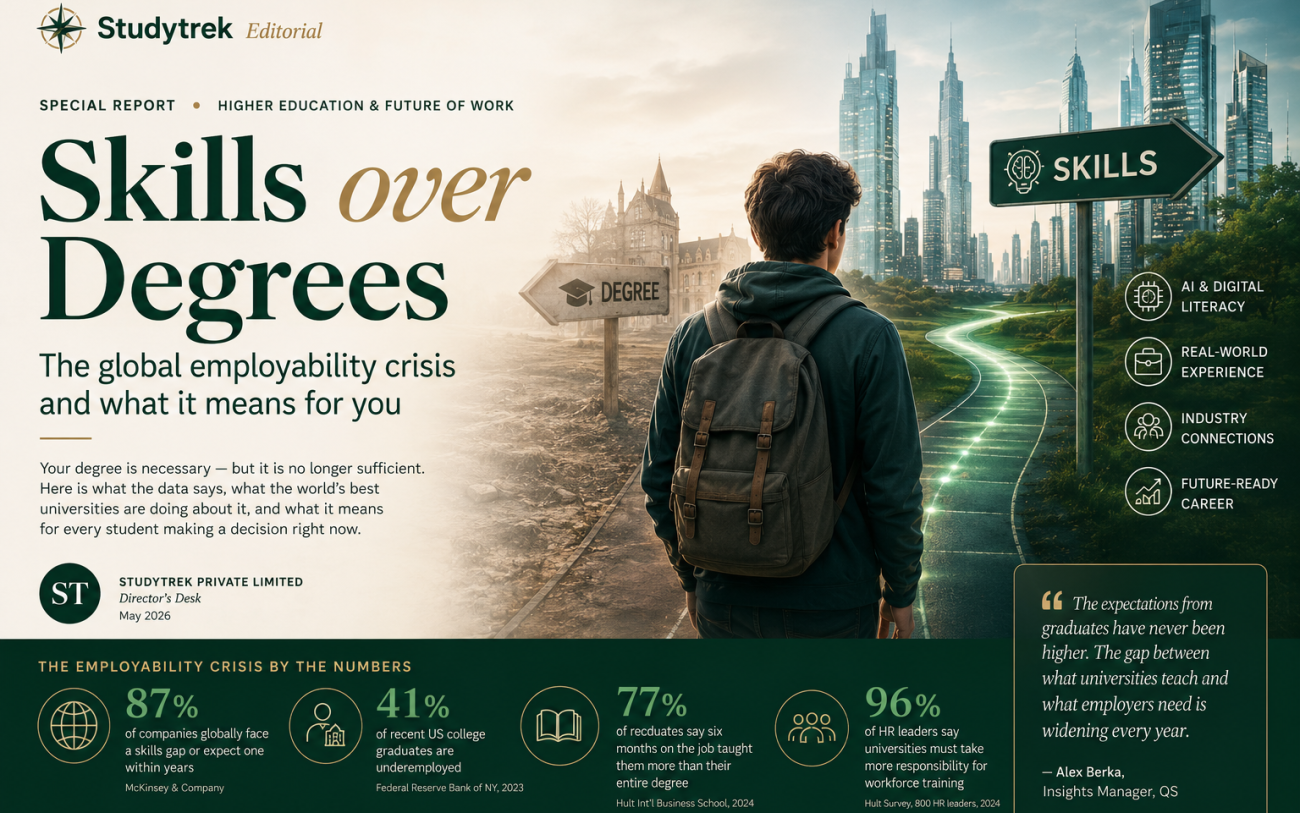
Your degree is not
your passport anymore.
More than half of university graduates worldwide are entering a workforce that doesn’t consider them fully ready. The credential you’re working toward is necessary — but it is no longer sufficient. Here is what the data says, what the world’s best universities are doing about it, and what it means for every student making a decision right now.
Picture this: you spend four years — and a significant amount of money — earning a degree from a respected university. You graduate. You apply for jobs. And then a recruiter tells you, politely, that you’re not quite what they had in mind. Not because you’re unqualified. Because you’re not work-ready.
This isn’t a hypothetical. It is happening to graduates across South Asia, Southeast Asia, Europe, and the United States at a scale that employers, economists, and now universities themselves can no longer ignore. And the gap between what a degree signals and what a job actually demands has been widening — quietly, steadily — for over a decade.
“The expectations from graduates have never been higher. The seismic shifts in automation, artificial intelligence and the new economy are only widening the gap between what universities teach and what employers need.”
— Alex Berka, Insights Manager, QS · EduData Summit 2024
A decade of evidence the system is broken
The employability crisis is not new. But the data from the last ten years has made it undeniable. Across every major research body that tracks the relationship between higher education and workforce outcomes, the same conclusion emerges: the credential is outpacing the capability.
Multiple sources, 2022–2025
Only 24% of recent graduates believe they have all the skills their current role demands — a finding from a Hult International Business School survey of 800 HR leaders and 800 young employees in the United States. Read that again. Three in four graduates feel underprepared on the job. And the employers agree: fewer than half of HR leaders said new hires “always” or “often” arrive with the critical thinking, communication, or adaptability the role requires.
QS Global Employer Survey 2024 · 85,000+ responses, 80 countries
The cost of getting this wrong is not just personal. McKinsey estimates the global skills gap could strip $8.5 trillion in annual revenues from the world economy by 2030. Businesses in the US alone spend $3.4 billion every year on remedial training for entry-level employees — training that, by rights, should have happened during the degree.
Skills are becoming the new curriculum architecture
Here is the important counterpoint: the universities that matter most in global hiring have read the same data. And they are changing — faster than most students realise.
Chronicle of Higher Education · The Pursuit · NACE 2024
What’s driving this? Employers, particularly in STEM and tech, have begun communicating something crucial to admissions offices: they want graduates who arrive with demonstrable skills, not just transcripts. The GEURS 2024 survey — 100,700 employer votes across 21 countries — found that digital literacy and STEM specialisation were the top two hiring criteria, ahead of university brand in most countries.
World Economic Forum, Future of Jobs Report 2025
The student’s dilemma — and how to resolve it
If you are a student choosing a university, a program, or a country to study in, this data changes the questions you should be asking. Not just “which university is ranked highest?” but “what will I be able to prove when I walk out the door?”
The WEF projects that 39% of workers’ skills will be obsolete within five years. The OECD highlights that only 11% of working-age adults in the EU were enrolled in any continuing education as of 2019. The implicit contract — study once, work forever — is broken. The universities now winning on employability rankings (GEURS 2026 top performers include Germany, France, Switzerland and Singapore) are those that embed this reality into their programs from day one.
What we tell every student who walks through our door
At Studytrek, we have watched this shift unfold in real time — in the profiles of students we place, in the feedback we receive from employer partners, and in the outcomes data we track from 2015 to today. The students who fare best in the global job market are not necessarily those who attended the most prestigious institutions. They are the ones who treated their degree as a foundation, not a finish line.
They took on real projects. They built demonstrable skills in fields that are growing — AI, data, sustainability, global communication. They chose programs that placed them in the world before graduation, not after. And they understood that in a world where 87% of companies are already navigating a skills gap, the graduate who walks in with evidence of what they can do is worth exponentially more than one who walks in with only a certificate of what they studied.
“A+ work stems from individuality, not automation. By resisting the temptation to outsource creativity entirely to AI, students can cultivate the distinctiveness that drives innovation.”
— Matthew Rascoff, Vice Provost for Digital Education, Stanford University
The global university system is correcting itself. The best institutions are moving toward skills-first, work-integrated education at a pace that was unimaginable even five years ago. Your job — as a student making one of the most consequential decisions of your life — is to find those programs, understand what they actually deliver, and use that knowledge to put yourself on the right side of a widening gap.
The degree still matters. But what you build alongside it will determine everything.